
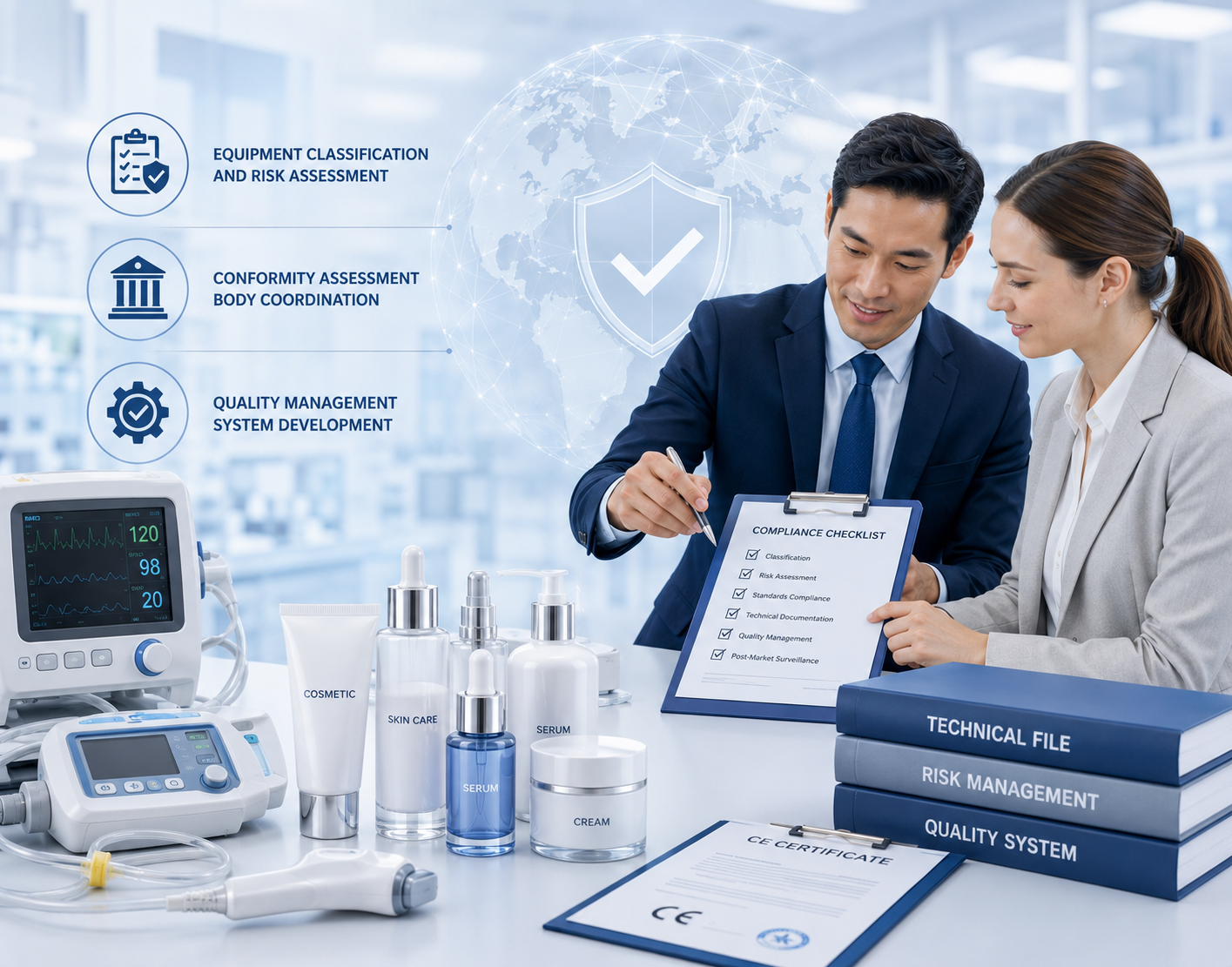
However, before a medical device can be commercially placed on the Malaysian market, the product must generally be registered with the Medical Device Authority, commonly known as MDA.
For overseas manufacturers, Malaysia medical device registration is not only a technical regulatory process. It is also a market-entry decision that affects distributor flexibility, registration control, long-term commercial strategy, and post-market compliance.
This guide explains the step-by-step process for foreign manufacturers that want to register medical devices in Malaysia, including the role of the local authorized representative, product classification, technical documentation, conformity assessment, MeDC@St submission, approval, and post-registration obligations.
The Medical Device Authority, or MDA, is the Malaysian authority responsible for regulating medical devices in Malaysia.
Medical devices in Malaysia are regulated under the Medical Device Act 2012, also known as Act 737. Under this framework, medical devices are required to be registered before they can be imported, exported, or placed on the Malaysian market.
MDA’s medical device registration information states that, under Section 5(1) of the Medical Device Act 2012, no medical device shall be imported, exported, or placed in the market unless the medical device is registered under the Act.
This means foreign manufacturers should treat registration as a required step before commercial supply in Malaysia.
For medical devices manufactured outside Malaysia, the registration is generally handled through a local authorized representative, commonly abbreviated as AR.
MDA’s registration guidance states that the persons responsible for registering a medical device would be the manufacturer and, in the case of a medical device manufactured in a foreign country, the AR of the foreign manufacturer.
In practical business terms, the AR may also be called:
- Medical device license holder;
- Independent license holder;
- Local representative;
- Registration holder;
- Malaysia medical device AR;
- Local regulatory representative.
The AR is important because it becomes the local regulatory bridge between the foreign manufacturer and the MDA.
For overseas manufacturers, the AR may support:
- Medical device registration submission;
- Communication with MDA;
- Coordination with conformity assessment bodies;
- Registration maintenance;
- Change notifications or amendments;
- Post-market communication;
- Coordination with importers and distributors;
- Local regulatory compliance.
This is why choosing the right AR is a strategic decision, not just an administrative requirement.
The first step is to confirm whether the product falls under the Malaysian definition of a medical device.
MDA describes medical devices as products such as instruments, apparatus, machines, appliances, implants, in vitro reagents, calibrators, software, materials, or similar articles intended for medical purposes, including diagnosis, prevention, monitoring, treatment, alleviation of disease, injury, physiological support, contraception, disinfection of medical devices, or diagnostic information from human specimens.
This assessment is important because some products may sit at the borderline between:
- Medical device;
- Pharmaceutical product;
- Cosmetic product;
- Food or health supplement;
- General wellness product;
- Personal protective equipment;
- Laboratory equipment;
- Consumer product.
- Wound care dressings;
- Skin repair products;
- Dental materials;
- Software applications;
- Wellness monitoring devices;
- In vitro diagnostic test kits;
- Disinfection products;
- Compression products;
- Aesthetic devices;
- Combination products.
Malaysia generally classifies medical devices based on risk. The common risk classes are:
- Class A - low risk;
- Class B - low to moderate risk;
- Class C - moderate to high risk;
- Class D - high risk.
- Registration requirements;
- Technical documentation expectations;
- Conformity assessment route;
- Government fees;
- Timeline;
- Review complexity;
- Post-market obligations.
| Risk Class | General Risk Level | Example Product Types |
| Class A | Low risk | Non-sterile examination gloves, simple hospital furniture, basic surgical instruments |
| Class B | Low to moderate risk | Certain wound dressings, some non-invasive devices, basic monitoring devices |
| Class C | Moderate to high risk | Infusion pumps, certain implant-related instruments, advanced wound care products |
| Class D | High risk | High-risk implantable devices, certain life-supporting devices, high-risk IVDs |
For foreign manufacturers, accurate classification is essential because incorrect classification may result in delays, rework, or rejection.
Once the product is confirmed as a medical device and the risk class is assessed, the foreign manufacturer should appoint a Malaysia AR.
The AR should generally be able to:
- Act as the local regulatory representative;
- Hold the relevant establishment license;
- Support the medical device registration process;
- Coordinate technical document review;
- Communicate with the MDA;
- Support post-market obligations;
- Coordinate with distributors and importers if needed.
This distinction is important. A distributor may need an establishment license for distribution activities, but for a foreign manufacturer’s product registration, the AR is the key registration party.
Foreign manufacturers often have two options:
- Appoint an independent AR / license holder; or
- Allow the local distributor to act as the registration holder.
Option 1: Independent License Holder Model
In this model, the foreign manufacturer appoints a neutral local AR to manage the registration.
The distributor is appointed separately for sales and market development.
This model is usually better when the manufacturer wants to:
- Maintain regulatory control;
- Appoint multiple distributors;
- Avoid distributor lock-in;
- Change distributors if needed;
- Keep registration separate from commercial sales;
- Build a long-term Malaysia market strategy.
In this model, the distributor holds or manages the registration.
This may be convenient in the beginning, but it can create commercial risks if:
- The distributor underperforms;
- The manufacturer wants to appoint another distributor;
- The distributor refuses to cooperate;
- The manufacturer wants to restructure the market;
- The manufacturer wants to transfer control later.
The next step is preparing the technical documentation required for Malaysia medical device registration.
The exact documentation depends on the device type, classification, risk profile, and registration pathway. However, manufacturers should generally prepare a complete technical file or Common Submission Dossier Template-style dossier.
Typical documents may include:
- Device description;
- Intended use;
- Indications for use;
- Product specifications;
- Product variants and model list;
- Accessories list;
- Design and manufacturing information;
- Essential principles checklist;
- Risk analysis and risk management report;
- Clinical evaluation or clinical evidence;
- Pre-clinical testing, where applicable;
- Biocompatibility reports, where applicable;
- Electrical safety reports, where applicable;
- EMC test reports, where applicable;
- Software validation documents, where applicable;
- Sterilization validation, where applicable;
- Shelf-life and stability data, where applicable;
- Packaging validation, where applicable;
- Usability or human factors documentation, where applicable;
- Declaration of conformity;
- ISO 13485 certificate;
- Certificate of market authorization, where applicable;
- Existing regulatory approvals from reference markets, where applicable;
- Product labels;
- Instructions for use;
- Brochures and promotional materials;
- Post-market history;
- Adverse event, recall, and field safety corrective action declaration.
Before submission, the manufacturer should review whether multiple models, sizes, or variants can be grouped under one application.
Product grouping can affect:
- Number of applications;
- Government fees;
- Conformity assessment fees;
- Timeline;
- Dossier structure;
- Quotation;
- Commercial launch plan.
Foreign manufacturers should not assume that all products can be grouped together simply because they belong to one brand. Factors such as intended use, risk class, design, technology, material, and manufacturing site may affect grouping.
A proper grouping assessment should be conducted before confirming the registration cost and timeline.
Malaysia registration may involve different levels of review depending on the product’s risk class and existing approvals.
Important factors include:
- Device class;
- Whether the product has approval from recognized reference markets;
- Whether the device is already marketed in other countries;
- Whether the device has safety issues or recalls;
- Whether the technical file is complete;
- Whether the device is sterile, active, implantable, software-based, or an IVD;
- Whether conformity assessment is required.
Because eligibility can depend on current requirements and supporting documents, manufacturers should confirm the exact route before quoting timelines to distributors or customers.
Depending on the device class and route, a conformity assessment may be required before the application is submitted to MDA.
Conformity assessment is typically performed by a registered conformity assessment body, often referred to as a CAB.
The CAB may review:
- Technical documentation;
- Quality management system evidence;
- Product safety and performance data;
- Clinical evidence;
- Labelling and IFU;
- Risk management;
- Existing approvals;
- Post-market history.
This step can significantly affect the timeline, especially for Class B, C, and D devices.
Medical device registration applications in Malaysia are submitted through MeDC@St, the Medical Device Centralized Online Application System.
MDA describes MeDC@St as a web-based online application system for establishment licensing and medical device registration, and states that it is a centralized system where applicants can apply for establishment licensing and medical device registration.
Through MeDC@St, the applicant submits the required product and establishment information, uploads supporting documents, and manages the application process.
For foreign manufacturers, the local AR usually manages the submission because the AR is the responsible local party for foreign-manufactured medical devices.
MDA publishes fees for medical device registration and establishment licensing.
According to MDA’s MeDC@St fee information, the application fees for medical device registrations are:
| Medical Device Class | Application Fee |
| Class A | RM500 |
| Class B | RM250 |
| Class C | RM500 |
| Class D | RM750 |
| Medical Device Class | Registration Fee |
| Class A | RM750 |
| Class B | RM1,000 |
| Class C | RM2,000 |
| Class D | RM3,000 |
| Medical device that contains a medicinal product | RM5,000 |
- AR’s annual fee;
- Regulatory consulting fee;
- CAB conformity assessment fee;
- Translation fee, if applicable;
- Documentation gap assessment fee;
- Registration amendment or maintenance fee;
- Distributor coordination fee, if applicable.
During the review process, questions may be raised by the CAB or MDA.
Common query topics include:
- Intended use clarification;
- Product classification;
- Product grouping;
- Risk analysis;
- Clinical evidence;
- Biocompatibility;
- Sterilization validation;
- Shelf-life data;
- Labelling and IFU;
- ISO 13485 scope;
- Free sale certificate details;
- Declaration of conformity;
- Manufacturing site information;
- Post-market history;
- Adverse event or recall records.
A good AR should help translate regulatory questions into clear action items for the manufacturer.
Once the review is completed and the application is approved, the medical device registration is granted.
After approval, the product can proceed toward market placement, subject to the relevant importation, distribution, labelling, and post-market requirements.
The manufacturer and AR should maintain a clear record of:
- Registration certificate or approval information;
- Approved product scope;
- Approved models and accessories;
- Approved intended use;
- Approved manufacturer details;
- Approved labels and IFU;
- Registration validity and maintenance requirements;
- Any conditions imposed by MDA.
After registration, the manufacturer may appoint importers and distributors to place the device in the Malaysian market.
MDA’s establishment license information states that no establishment shall import, export, or place in the market any registered medical device unless it holds an establishment license.
This means distributors and importers should have the appropriate establishment licenses for their respective activities.
A common structure for foreign manufacturers is:
- The AR holds or manages the registration;
- The importer handles importation;
- The distributor handles sales and supply;
- The manufacturer maintains product responsibility and technical support.
Registration approval is not the end of regulatory responsibility.
After the product is placed on the Malaysian market, the manufacturer and local representative should manage post-market obligations.
These may include:
- Complaint handling;
- Adverse event reporting;
- Field safety corrective actions;
- Recall communication;
- Product change assessment;
- Registration amendments;
- Labelling updates;
- Distributor control;
- Importation records;
- Post-market surveillance records;
- Renewal or maintenance activities, where applicable.
A simplified flow may look like this:
- Confirm whether the product is a medical device;
- Determine the product risk class;
- Appoint a Malaysian AR;
- Review whether to use independent license holder or distributor registration model;
- Collect technical documents;
- Review product grouping;
- Confirm registration pathway;
- Complete conformity assessment, if required;
- Submit application through MeDC@St;
- Pay relevant fees;
- Respond to MDA queries;
- Obtain medical device registration approval;
- Coordinate importer and distributor arrangements;
- Maintain post-market compliance.
The registration timeline depends on the device type, risk class, route, document readiness, CAB review, MDA review, and query response time.
Key factors affecting timeline include:
- Class A, B, C, or D classification;
- Whether the device has prior approval in recognized markets;
- Whether conformity assessment is required;
- Completeness of technical documents;
- Number of models and variants;
- Whether the product is sterile, active, implantable, software-based, or an IVD;
- Whether there are prior adverse events or recalls;
- How quickly the manufacturer responds to queries.
The cost depends on several components:
- MDA application fee;
- MDA registration fee;
- CAB conformity assessment fee, if applicable;
- AR or license holder fee;
- Regulatory consulting fee;
- Technical file gap review;
- Translation or document preparation fee;
- Grouping complexity;
- Registration amendments;
- Post-market maintenance.
Mistake 1: Letting the First Distributor Hold the Registration Without Strategy
This may seem easy at first, but it can create distributor lock-in later.
If the distributor controls the registration, the manufacturer may face difficulties appointing additional distributors or changing commercial partners.
Mistake 2: Starting Without Confirming Product Classification
Wrong classification can lead to incorrect documentation, incorrect fees, wrong timeline expectations, and unnecessary delays.
Mistake 3: Underestimating Technical Documentation Requirements
Malaysia registration requires complete technical documentation. Missing risk analysis, clinical evidence, test reports, or labelling documents can slow down the process.
Mistake 4: Not Checking Grouping Early
Grouping affects cost and timeline. Manufacturers should confirm whether multiple models can be submitted together before issuing commercial plans or distributor quotations.
Mistake 5: Assuming Foreign Approval Automatically Guarantees Fast Approval
Existing approvals from recognized markets may help, but manufacturers still need to meet Malaysian requirements and provide complete supporting documents.
Mistake 6: Ignoring Post-Market Obligations
Registration approval does not remove the need for complaint handling, adverse event reporting, field safety corrective action communication, and change control.
Mistake 7: Choosing the Cheapest Local Representative
A low-cost representative may not provide sufficient regulatory support, distributor coordination, or post-market compliance management.
For foreign manufacturers, the AR should be chosen based on reliability, licensing status, regulatory experience, commercial neutrality, and long-term support capability.
Foreign manufacturers should decide early whether the registration should be held by:
- An independent AR; or
- A commercial distributor.
- More control over registration;
- Freedom to appoint multiple distributors;
- Lower risk of distributor lock-in;
- Easier distributor replacement;
- Clear separation between regulatory and sales roles.
- The distributor is exclusive and highly trusted;
- The distributor is investing heavily in market development;
- The manufacturer has no intention to appoint other distributors;
- The commercial agreement strongly protects the manufacturer.
A practical model may look like this:
Phase 1: Regulatory Entry
Appoint an independent Malaysia AR to manage registration.
Phase 2: Product Registration
Prepare documents, complete conformity assessment where required, and submit the MDA application through MeDC@St.
Phase 3: Distributor Appointment
Appoint one or more distributors after confirming product strategy, pricing, and channel coverage.
Phase 4: Market Expansion
Expand across private hospitals, public hospitals, clinics, laboratories, tenders, or regional distributors.
Phase 5: Long-Term Control
Maintain registration through the independent license holder while retaining flexibility to adjust distributor arrangements.
This model allows foreign manufacturers to enter Malaysia without immediately setting up a local company or becoming dependent on one distributor.
Before starting Malaysia MDA medical device registration, foreign manufacturers should ask:
- Is the product considered a medical device in Malaysia?
- What is the correct risk class?
- Is the product Class A, B, C, or D?
- Do we need an AR?
- Should we use an independent license holder or distributor registration model?
- Do we have a complete technical file?
- Do we have ISO 13485 certification?
- Do we have existing approvals from reference markets?
- Do we have a market authorization certificate?
- Can our models be grouped under one application?
- Is conformity assessment required?
- What is the estimated timeline?
- What are the MDA fees and CAB fees?
- Who will manage post-market compliance?
- Who will import and distribute the product after approval?
1. What is MDA medical device registration in Malaysia?
MDA medical device registration is the process of registering a medical device with Malaysia’s Medical Device Authority before the device is imported, exported, or placed on the Malaysian market. MDA states that no medical device shall be imported, exported, or placed in the market unless registered under the Medical Device Act 2012.
2. Can a foreign manufacturer register a medical device in Malaysia?
For foreign-manufactured medical devices, the responsible party for registration is the authorized representative, usually abbreviated as AR, of the foreign manufacturer.
3. What is a Malaysia medical device authorized representative?
A Malaysia medical device AR is a local party appointed by a foreign manufacturer to represent it for regulatory purposes, including product registration and regulatory communication with MDA.
4. Is an authorized representative the same as a license holder?
In commercial discussions, “license holder” often refers to the local AR or registration holder. The more regulatory term in Malaysia is “authorized representative” or “AR”.
5. Does the authorized representative need an establishment license?
Yes. MDA states that an establishment must hold an establishment license to import, export, or place registered medical devices on the market, and the definition of establishment includes an AR appointed by a foreign manufacturer.
6. What is MeDC@St?
MeDC@St, namely the Medical Device Centralised Online Application System, is MDA’s online system for establishment licensing and medical device registration applications. MDA describes it as a web-based centralized online application system.
7. What documents are needed for Malaysia medical device registration?
Documents may include device description, intended use, product specifications, risk analysis, clinical evidence, essential principles checklist, labelling, IFU, ISO 13485 certificate, declaration of conformity, existing approvals, test reports, and post-market history.
8. How long does Malaysia medical device registration take?
The timeline depends on product class, conformity assessment requirements, technical document readiness, MDA or CAB queries, grouping complexity, and whether the device has existing approvals from recognized markets.
9. How much does Malaysia medical device registration cost?
The cost includes MDA fees, CAB fees where applicable, AR fees, consulting fees, document review fees, and maintenance fees. MDA’s MeDC@St page lists official application and registration fees by device class.
10. Should a foreign manufacturer use an independent license holder or distributor for Malaysia registration?
An independent license holder is usually better if the manufacturer wants long-term control, multiple distributor flexibility, and lower distributor lock-in risk. Distributor registration may be suitable only when the distributor is trusted, exclusive, and contractually aligned with the manufacturer’s long-term strategy.
Malaysia MDA medical device registration is a critical step for foreign manufacturers planning to enter the Malaysian healthcare market.
The process usually involves confirming whether the product is a medical device, determining the risk class, appointing a Malaysian AR, preparing technical documentation, completing conformity assessment where required, submitting through MeDC@St, responding to queries, obtaining approval, and maintaining post-market compliance.
For overseas manufacturers, the most important strategic decision is often not only how to register the product, but who should hold and manage the registration.
Using an independent AR or medical device license holder can help foreign manufacturers enter Malaysia without setting up a local company, avoid distributor lock-in, appoint multiple distributors, and maintain long-term control over their market access strategy.
We support foreign medical device manufacturers with Malaysia MDA medical device registration, authorized representative services, independent license holding, establishment license support, conformity assessment coordination, distributor coordination, and long-term regulatory maintenance.
Whether you are entering Malaysia for the first time or restructuring your distributor model, our team can help you build a compliant and flexible market-entry strategy.
Contact us today to discuss your Malaysia medical device registration requirements.